Showing posts with label user-centered service. Show all posts

Next Generation Information Discovery

Information "discovery" for engineers and scientists at NASA is generally:
  • serendipitous
  • random
  • self led
  • limited to known sources (insular)
  • last minute
  • satisficing

Our goal is to provide specific, customized information solutions that provide content they didn't know they needed and can't live without.

Custom Research Modules:

  • using existing RSS technology to its fullest extent
    • Embeded
    • Real-time and automated
  • free
  • low maintenance


Custom Database Search Module

(e.g. Engineering Village2) + Springwidgets.
  • Pros:
    • robust, professionally constructed searches
    • embeded
    • real-time automated delivery
    • branding
  • Cons: limited to databases that provide custom rss feeds.

Custom Federated Search

with Delicious + deliSearch + Widgetbox
  • Pros:
    • "cheap" federated searching
    • embeded
    • customized to topic
  • Cons: still requires search strategy to be formulated by the researcher
Example:  The below widget displays librarian-chosen resources relating to microgravity and (in a separate tab) articles from Engineering Village related to microgravity (viewable inside the NASA domain only).

Combined Custom Module

with Yahoo!Pipes
  • Pros:
    • professionally constructed sources and search
    • highly configurable
    • embeded
    • real-time automated delivery
  • Cons:
    • Pipes requires a large learning curve
    • branding?
Example:  The below example uses Pipes to search IEEE Xplore database for Space Applications in Nanotubes and removes the IEEE Xplore title from each prior to posting so that users see the most relevant information.  See the Pipe here.

    Nanotubes in Space Applications


    This outline represents a presentation I gave at the 2008 IEEE Library Advisory Council's annual meeting in New York City.
    Clusty Clouds!

    One of my favorite search engines, Clusty, has a terrific feature that lets you embed a real-time, search query tag cloud into any website. Like this one below for Nanotechnology:

    Loading Clusty Cloud ...

    This is a wonderful way to display search results on a subject oriented page. If you apply your librarian mind to it you can create one that is really useful and time saving for patrons:

    How about taking out all the noisy information about the iPod nano, and limiting it to "space applications" (instead of say, biomedical applications) and only info from nasa.gov?


    Loading Clusty Cloud ...


    Now you have created a sophisticated search that yields specific results and saves your patrons time. Since tag clouds use size as a frequency indicator, clicking on the largest word, communication (remember this is real-time so that may not be the largest word at reading time) yields 86 succinct results. Now type nanotechnology and communications into Google...see?

    I think this would be a great addition to a subject guide created in LibGuides. I will be working on how to include the cloud and have the resulting page load inside the LibGuide. Cross your fingers.

    Library v. The Gap


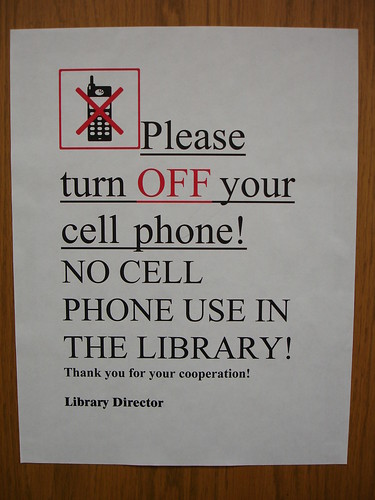
    There is an interesting group on flickr that is collecting Library Signage. (btw, we need to compile a list of often used library words that word processing programs think are spelled wrong - to get started: browsable, findability, signage...). Look through some of them and wonder if your local retail establishment would hang them. We have a tendency to TALK IN ALL CAPS, use strong words like NEVER, NOT, and UNDER NO CIRCUMSTANCES. We like to underline things and use red - the quintessential color of "thou shalt not."

    For example, in my library we had many DO NOT RESHELVE (also considered misspelled) signs. Now here is a sign with a purpose - we want to count what was used, we want to put it back where it goes, and we don't want to burden you, our lovely patron, with the task. But, "DO NOT RESHELVE" is the best way we could find to say that??

    Where are our please and thank you and this is your collection not mine. Do we sometimes act as if it is our collection and that patrons are "messing it up"? I can admit to feeling this way sometimes. What would happen if we flipped this idea on its head? The collection belongs to the patrons - we are only stewards of it and our stewardship should never restrict or encumber the use of the information.

    Please allow us to reshelve your journals

    A Rose by any other name would be...a Database?

    Have you ever had the "database" argument with a fellow library co-worker? You know the one where you want to put Science Direct on the database links and they say "but that is a collection of ejournals, not a database!"?

    I was heartened to find I'm not the only one beating my head against this brick wall from time to time Library 2.0: An Academic's perspective had a wonderful story about her fight to put Google Scholar on the proxy list at her school. One of the arguments here was that Google Scholar was a "search engine" and not a database.

    Really??

    So what is a database? Google (gasp! she used Google!) has a varied list of definitions for the word database. I like the simplicity of WordNet's definition: An organized body of information. Simple. All encompassing. By this definition my bookshelf is a database. hmmm.

    Ok, let's try again. Alt web's definition is : A computerized collection of information. Ok, so my bookshelf is not a database. But my email inbox is?

    Ok, one more time.
    The Wildlife Society remote sensing working group defines a database as: Relational data structure used to store, query, and retrieve information. Ah, much more technical. A computer scientist would like the definition. Here we have another piece of the equation - store? query? retrieve? Suddenly this organized body of information has meaning.

    I guess my working definition of a database would be: a computerized collection of information that is organized in a way that bring meaning to the collection and is able to be manipulated for use.

    Working in different libraries I have seen many unsaid definitions of database in action:
    • A database is something subscribed not free
    • A database has vocabulary control
    • A database has bibliographic records
    • etc.

    All of these seem to me to be attempts for libraries to control the data and information. To put reins on it and keep it in check. Are we afraid if we "let" them use a "non-librarian approved" database that they won't respect us in the morning?

    I guess it comes down to what a library feels its mission is. Is your mission to teach and proscribe that information must come from these sources? Only your sources are accurate and right and we will snub our noses at those unwashed masses of other sources. Or, is your mission to help people find and use information. period. People - in all their messy preferences and quirks. Information - in all its messy and unorganized and uncontrolled beauty. And bring the two together - wherever, whenever.

    If our patrons want to use google scholar or science direct or whatever - what do we gain by scolding them? Obsolescence.

    I think we fear obsolescence and that in our fear we are realizing just that. If they use google scholar - what will our jobs be? I say, don't worry! They don't use google scholar well, trust me. They need help and guidance and alternatives at their fingertips when they grow tired of trudging through. And a librarian will be there to pick up the pieces.

    Beauty and the Geek: 3rd Party Content on Library Websites

    I was recently at a meeting where a discussion of inclusion of 3rd party content in an information resource arose as a topic. The specific topic centered around 3rd party content hosted along side search results in a research database but this brings up and interesting disconnect that I have encountered here at my Library. That is: what responsibility do librarians have to the validity of 3rd party content?

    One camp sits firmly in the "if it isn't properly vetted it doesn't belong anywhere near authoritative sources." I recently ran into this on a news feed I include on my library's webpage (homepage no less). I have an aggregator troll the web for news about my organization and use Feedigest to display the results. And, by web, I mean that whole, huge, messy thing called the World Wide Web. This content is hardly vetted! The concerns came when we recently had a news item involving the TV reality show Beauty and the Geek. Panic! There is non-technical, markedly non-relevant material right on the LIBRARY HOMEPAGE! *faint* This camp believes in information beauty - and beautiful information is authoritative, relevant, and (usually) paid for.

    The other camp (of which I tend to spend a night or two) believes that information only has value when assessed by the reader and it can not be held back by the strictures of "relevance" or "authority." After all, one person's irrelevant is another person's eureka! moment. Information must be free! "You can't stop the signal!" ($5 if you can name that movie!). This camp is the Geek camp - maybe including, but not limited to, "millennials" that have grown up downloading free music and getting their news from blogs.

    I think there is an important middle ground with valuable opportunities for Librarians. The "Beauty" camp is missing the forest for the trees - end-users are already going elsewhere to get their information! They are going to Google and Yahoo and The Onion. They are deciding for themselves what is relevant and authoritative. Are they doing this well? Perhaps not. But they ARE doing it. Ignoring that fact and being information "purists" is counterintuitive. The "Geeks" aren't getting it right either. One of the value-added services librarians provide are filtering of information noise and some level of validation of authority. This is not a role to be taken lightly in an ever pouring deluge of information assaulting our patrons.

    Wherever shall the twain meet?

    I think there are two ways that librarians can utilize 3rd party content without abandoning Beauty for the Geek.
    1. Notification of content types. There are several, evermore obvious ways to delineate your content. In my library we differentiate between subscribed and unsubscribed content and there are several ways to do this.
      1. Post a content policy on your page. Of course, like a EULA, no one will ever read it but at least it is there.
      2. On my library website we use a small icon to designate subscribed and non-subscribed content. This is minimally intrusive. On included RSS feeds the news service usually includes a "brought to you by..." branding.
      3. Another method is to separate content by chunking subscribed separate from unsubscribed content on a page or even on separate pages. I do not like this method because information is information to the patron - they don't care how we acquired it.
      4. The most intrusive method would be a middle-page that a patron hits before proceeding that informs them they are about to view a page that has not been reviewed. This method can be annoying from a usability perspective and I am not a fan of this. Ultimately it will depend on the sensitivity of the user community.
    2. Vetting the source. This is the most obvious one to me. If I have put it on our library webpage then I have vetted it to some extent. I might not be able to screen every news item but I do generally trust Yahoo! as a news source and I have created a search string that I believe will minimize noise and maximize relevance. For example, I have an included RSS feed on my Nanotechnology subject guide that searches Yahoo! news for the following string: Yahoo! News search results for [nanotechnology OR nano-technology OR Nano* -apple -ipod]. As far as I'm concerned this is a vetted resource. Using Feedigest I can also mash this news feed with news from nanotechnology.com and nanotech-now.com to create a single consolidated source for my patrons. If I one day get a news item about a reality show because one of the contestants once bombed a nanotech firm - then cest la vie! This is still less noise than my patron typing "nano" into Google.
    So is it worth it?

    I think that the benefits of this type of content are worthwhile. With integration of additional content your library site can be:
    • Be the one-stop information source for your patrons
    • Save them time in sorting their own results
    • Provide real-time, value-added information
    So, Beauties don't throw out this juicy content! Geeks don't drown us in free information! Get together - hold hands - it is a beautiful geektastic thing.

    Delicious Mashups! The New Library Webpage

    Using free online tools, we were able to offer real-time content to our users. This presentation outlines our implementation of Web 2.0 technologies.